

Electronic Booking vs. Phone Calls: Why It Matters
How electronic freight booking saves 15-30 minutes per shipment, reduces errors, and gives you control over your shipping operations.
 David Chen•Jun 17, 2024
There’s a reason the phrase “just call the carrier” has survived so long in freight. For decades, picking up the phone was the only way to get a rate, book a pickup, or track a shipment. Carrier reps knew your account, your lanes, your preferences. It worked.
But it worked like a fax machine works. Functionally. Slowly. With a lot of wasted time built into every transaction.
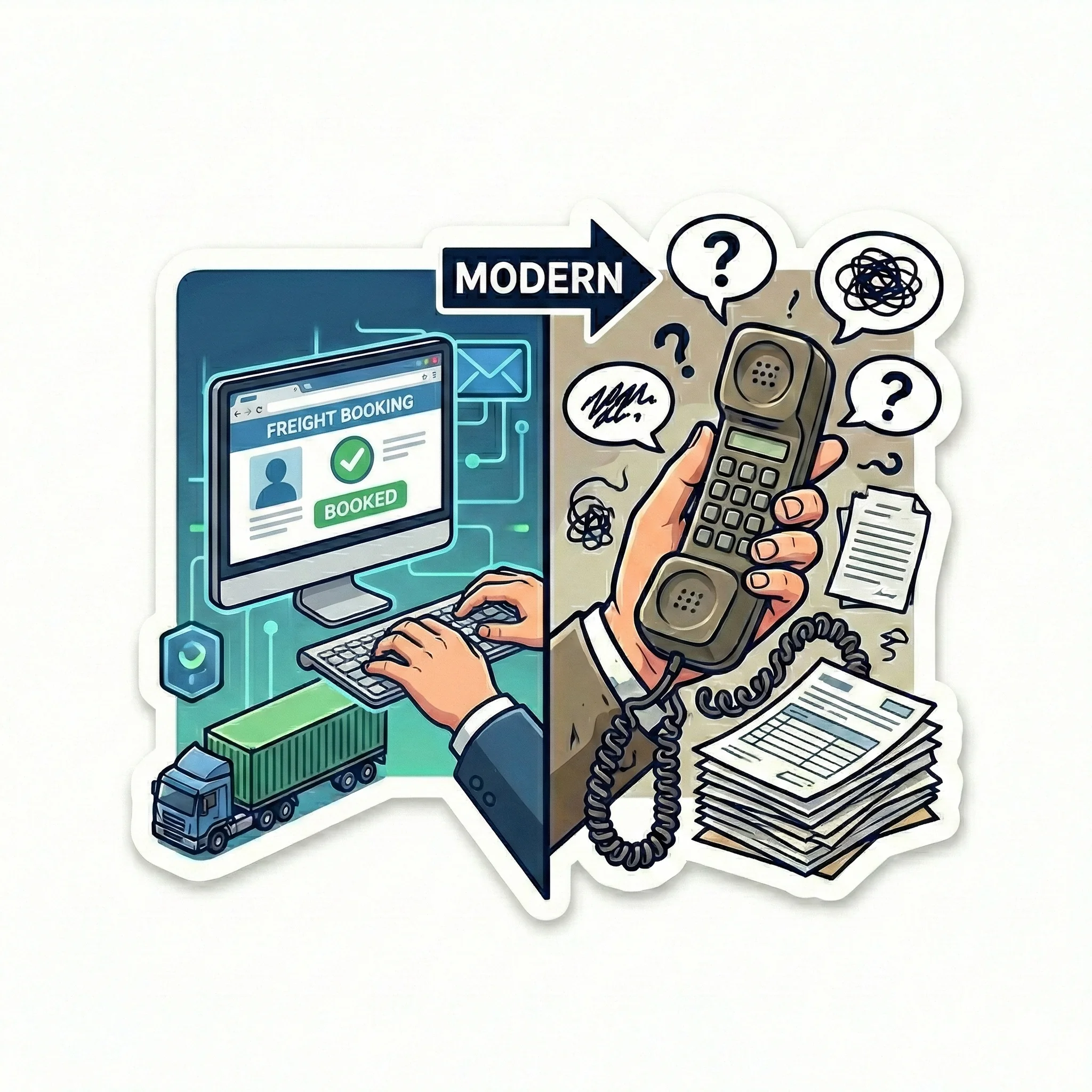
Let’s look at what actually happens during a phone-based shipment versus an electronic one, and quantify why the difference matters.
A phone-based shipment, step by step
You need to ship two pallets from your warehouse in Ontario to a customer in Ohio. Here’s the typical phone-based process:
Getting quotes (20-40 minutes). You call Carrier A. You’re on hold for 8 minutes. You give the rep your details: pickup address, delivery address, two pallets, 1,200 pounds, Class 85, no liftgate needed. They put you on hold again while they calculate. You get a rate. Now repeat with Carrier B and Carrier C to make sure you’re getting a fair price. Total time: 20-40 minutes if you’re lucky.
Booking (10-15 minutes). You call back the carrier with the best rate. Hold time again. You confirm the details. The rep reads them back. You confirm the pickup date. They give you a PRO number. You write it down (or they email it to you eventually).
Paperwork (10-15 minutes). You manually fill out the BOL. You retype the addresses, weights, and descriptions that you just gave over the phone. You print it and bring it to the dock.
Tracking (5-10 minutes per check). You want to know where your shipment is. You call the carrier, navigate the phone menu, give them your PRO number, and wait while they look it up. Or you log into their portal (if you can remember the password) and search.
Total time per shipment: 45-80 minutes. And that’s when everything goes smoothly. Add in miscommunication, callback requests, and wrong numbers and it gets worse.
The same shipment, electronically
Getting quotes (2-3 minutes). You enter your shipment details once. Rates from multiple carriers appear instantly. You compare price, transit time, and carrier ratings side by side.
Booking (1-2 minutes). Click to select the best option. Confirm the pickup date. Done. You get immediate confirmation and a PRO number.
Paperwork (0 minutes). The BOL is generated automatically from the data you already entered. It’s formatted correctly and ready to print or share digitally.
Tracking (30 seconds). Open the dashboard. Your shipment status is right there with real-time updates. No phone calls, no portal hunting.
Total time per shipment: 3-5 minutes.
The numbers at scale
For a single shipment, saving 40-75 minutes is nice but not life-changing. At scale, the math gets serious.
| Metric | Phone-based | Electronic |
|---|---|---|
| Time per shipment | 45-80 min | 3-5 min |
| Monthly time (20 shipments) | 15-27 hours | 1-1.5 hours |
| Annual time (240 shipments) | 180-320 hours | 12-20 hours |
| Booking error rate | 8-15% | 1-3% |
| After-hours availability | None | 24/7 |
Those 180-320 hours per year are worth $5,400-$16,000 in labor costs (at $30-$50/hour). That’s before you account for the cost of errors, which we’ll get to.
The error problem
Phone-based booking introduces errors at every step. The rep mishears “1,200 pounds” as “1,020 pounds.” The delivery address gets transposed. “No liftgate” gets entered as “liftgate required” and you’re charged $125 you didn’t need.
These errors compound:
Wrong weight leads to reweigh charges and rate adjustments. Average cost: $75-$200 per incident.
Wrong address leads to failed delivery, redelivery charges, or returned freight. Average cost: $150-$300 per incident.
Missing accessorials leads to surprise charges on your invoice. Average cost: $50-$200 per incident.
Wrong freight class leads to reclassification charges. Average cost: $100-$300 per incident.
If 10% of your phone-booked shipments have errors averaging $150 each, that’s $3,600 per year on 240 shipments. With electronic booking, where data is entered once and validated automatically, error rates drop to 1-3%.
”But I like my carrier rep”
This is the most common objection to electronic booking, and it’s valid. Good carrier reps provide real value. They know your freight profile, they can get you capacity when things are tight, and they’ll fight for you on claims.
Here’s the thing: electronic booking doesn’t eliminate the relationship. It eliminates the repetitive transactional work. Your carrier rep’s time is better spent solving problems and providing strategic advice than reading back addresses and confirming ZIP codes.
Modern freight platforms also give you access to more carriers, not fewer. Instead of being locked into relationships with two or three carriers, you can compare 100+ and still build relationships with the ones that consistently perform best on your lanes.
The audit trail advantage
When everything is verbal, disputes become he-said-she-said situations. “We quoted you $450.” “No, your rep said $380.” Good luck resolving that without a recording.
Electronic platforms create a complete audit trail: the original quote, the booking confirmation, the BOL, tracking events, and the invoice. When something goes wrong (and eventually something always does), you have documentation to support your position.
This matters most for:
- Billing disputes: You have the quoted rate in writing
- Claims: You have timestamped tracking data showing when delays occurred
- Accessorial disputes: You have records of what services were requested at booking
- Performance reviews: You have data on carrier transit times, on-time rates, and error frequency
Making the switch
If you’re currently phone-based, you don’t need to switch everything overnight. Start with your simplest, most repetitive lanes. Get comfortable with the platform. Then expand to more complex shipments as you build confidence.
Most companies that make the switch see immediate time savings and report that within a month, they can’t imagine going back to phone-based booking.
How FreightSimple helps
FreightSimple was built specifically to eliminate the phone-call-and-wait cycle. Get instant quotes from 100+ carriers, book in minutes, and track everything from a single dashboard. All with an audit trail for every shipment.
Try electronic booking on your next shipment and see the difference.
Frequently Asked Questions
How much time does electronic freight booking save?
Electronic booking saves 15-30 minutes per shipment compared to phone-based booking. For a company shipping 20 times per month, that's 5-10 hours saved monthly. The savings come from instant rate comparison, auto-populated forms, immediate confirmation, and elimination of hold times.
Is electronic freight booking less accurate than working with a person?
Electronic booking is actually more accurate. Phone-based booking relies on verbal communication, which introduces errors in addresses, weights, dimensions, and special instructions. Electronic systems validate data at entry, auto-fill from previous shipments, and create an audit trail. Companies switching to electronic booking typically see booking error rates drop by 60-80%.